Living soil cannabis produces richer terpene profiles through billions of microbial interactions. Here's the science behind why soil biology creates better flower.
What Is Living Soil Cannabis?
Living soil is exactly what it sounds like — soil that is alive. Not sterile growing medium with nutrients added from a bottle. Actual earth teeming with billions of bacteria, fungi, protozoa, nematodes, and earthworms, all working in an interconnected web to convert organic matter into the precise nutrients a cannabis plant needs, exactly when it needs them.
In conventional cannabis cultivation — whether hydroponic, coco coir, or synthetic soil — the grower acts as the plant's digestive system. They measure nutrients, mix solutions, adjust pH, and feed the plant on a schedule. The plant absorbs what it is given.
In living soil, the soil itself is the digestive system. Microorganisms break down organic matter into plant-available forms. Mycorrhizal fungi extend root networks by hundreds of times their natural reach. Bacterial colonies convert nitrogen from the atmosphere into compounds the plant can use. The plant sends chemical signals through its roots requesting specific nutrients, and the soil biology responds.
This is not a novel technique. It is how plants have grown for 400 million years. The novel thing is growing cannabis without it.
The Microbiology Behind the Flavor
The soil food web beneath a cannabis plant is a civilization of extraordinary complexity. Understanding it explains why living soil flower smells, tastes, and feels different from hydroponic cannabis.
Mycorrhizal fungi form symbiotic relationships with cannabis roots, extending hyphal networks that increase the root's absorptive surface area by 300 to 800 times. A 2022 study in Frontiers in Plant Science found that cannabis plants inoculated with arbuscular mycorrhizal fungi showed enhanced biomass and increased cannabinoid concentrations compared to uninoculated plants. A 2025 field trial in the northeastern United States documented mycorrhizal colonization rates up to 45% in regenerative organic systems, with corresponding improvements in nutrient uptake and stress tolerance.
Plant growth-promoting rhizobacteria (PGPR) — beneficial bacteria living in the root zone — directly influence secondary metabolite production. A 2023 study in the Journal of Agricultural and Food Chemistry found that PGPR inoculation increased THCA and CBDA levels significantly, with one bacterial species (Mucilaginibacter) producing 23% increases in total terpene accumulation when applied at the flowering stage.
Endophytes — microorganisms living inside the plant tissue itself — modulate cannabinoid and terpene biosynthesis from within. A 2020 review in Microorganisms found that endophyte inoculation increased flower dry weight by 24%, total CBD by 11%, and THC by nearly 12%.
The takeaway is direct: the diversity of life in the soil translates to chemical complexity in the flower. More microbial diversity below ground means richer terpene profiles and more nuanced cannabinoid expression above ground. This is not marketing. It is measurable biochemistry.
How Living Soil Produces Better Terpenes
Terpenes are defense compounds. Cannabis produces them in response to environmental stress — UV radiation, temperature fluctuation, pest pressure, and crucially, signals from the soil microbiome. A plant growing in biologically active soil receives a constant stream of microbial communication that triggers secondary metabolite production.
The Columbia University study published in Molecules in 2023 tested this directly. Researchers compared genetically identical cannabis plants grown outdoors in living soil under natural sunlight against the same genetics grown indoors in synthetic medium under LED lighting. The results were unambiguous.
Sun-grown, soil-cultivated samples had significantly greater diversity and quantity of terpenes. Beta-caryophyllene, alpha-humulene, alpha-bergamotene, alpha-guaiene, and germacrene B were all present at markedly higher concentrations in the outdoor living soil plants. The outdoor samples also contained fewer degraded cannabinoids — meaning the compounds arrived at harvest in better chemical condition.
A 2024 study in Frontiers in Plant Science confirmed that soil sterilization significantly altered the microbial communities within cannabis seedlings, demonstrating that the living soil microbiome directly shapes the plant from its earliest days.
When you open a jar of living soil cannabis and the aroma fills the room — complex, layered, with notes you can actually distinguish — you are experiencing the cumulative effect of billions of microbial interactions that shaped that flower's chemistry from seed to harvest.
Living Soil vs Hydroponic Cannabis
Let's be direct about what each system does well and where each falls short.
Hydroponic and synthetic systems offer precision control. The grower dictates exactly which nutrients reach the plant at exactly which concentrations. This produces consistent, predictable results. It can push THC percentages high because the plant receives exactly what maximizes cannabinoid production. For commercial operations prioritizing yield and THC numbers, hydroponics is efficient.
Living soil sacrifices some control for complexity. The plant negotiates with its soil microbiome for nutrients rather than receiving them on a schedule. This negotiation — this biological conversation — produces a broader, more nuanced chemical profile. Terpene expression is richer. The entourage of minor cannabinoids is more diverse. The experience of the flower is more layered.
The difference is analogous to wine. Hydroponic grapes grown in a controlled environment produce consistent, drinkable wine. Grapes grown in challenging terroir — real weather, mineral-rich soil, genuine seasons — produce wines with character that reflects a place.
The honest answer is that neither system is universally superior. But if what you value is complexity of aroma, depth of effect, and a flower that genuinely tastes like somewhere — living soil is the system that delivers it.
The Environmental Case for Living Soil
The environmental argument is no longer debatable. It is documented.
A March 2025 study by Lawrence Berkeley National Laboratory published in One Earth found that indoor cannabis cultivation accounts for approximately 62% of the cannabis industry's total greenhouse gas emissions, despite producing a fraction of global supply. The entire cannabis industry generates roughly 44 million metric tons of CO₂-equivalent per year — comparable to 10 million cars. Indoor cultivation's energy consumption rivals that of all other crop production globally.
Outdoor, soil-based cultivation accounts for just 9% of industry emissions. The study concluded that shifting from indoor to outdoor production could reduce cannabis industry emissions by up to 76%.
A 2021 study in Nature Sustainability quantified indoor cannabis production at 2,283 to 5,184 kg CO₂-equivalent per kilogram of dried flower. One kilogram of indoor cannabis generates approximately the same carbon emissions as driving a car for an entire year.
Living soil cultivation eliminates synthetic nutrient runoff, reduces water usage through improved soil structure and moisture retention, and actively sequesters carbon. Cover crops and composted plant material return carbon to the soil each season. The soil gets richer over time rather than depleted — the opposite of extractive agriculture.
How Sunkissed Farm Builds Living Soil
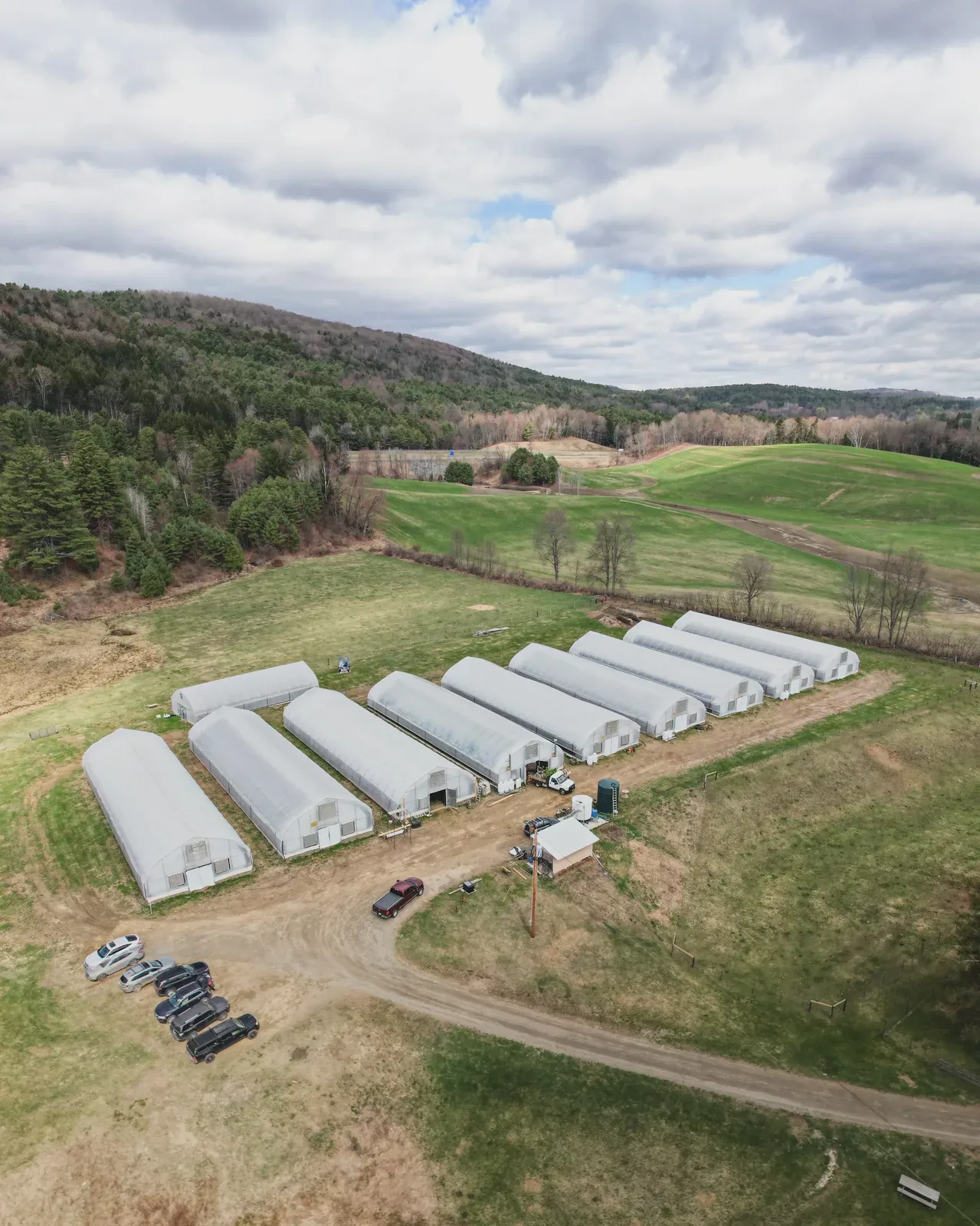
Twenty-nine acres in Windsor, Vermont. The Connecticut River floodplain where it meets the Green Mountains foothills. The land has supported crops since 1805 — over two centuries of river deposits creating soil of extraordinary fertility. This is where we build living soil.
Our approach starts with the understanding that soil biology is not built in a season. It is accumulated over years of intentional practice. Every decision — what we plant, what we compost, what we leave alone — is designed to support the microbial community beneath our fields.
Cover cropping is the foundation. Between cannabis seasons, our fields grow nitrogen-fixing legumes and deep-rooted plants that feed the soil food web, prevent erosion, and add organic matter when turned back into the earth. These are not placeholder crops. They are investments in the biology that will feed next season's cannabis.
Compost teas — microbially rich liquid brews made from our own compost — are applied as soil drenches to reinforce beneficial bacterial and fungal populations. Each application reintroduces billions of microorganisms that accelerate nutrient cycling and strengthen the plant's immune response to pests and pathogens.
Beneficial insects serve as our pest management. Rather than synthetic pesticides that devastate soil biology along with target pests, we cultivate habitat for predatory insects that keep pest populations in check. The result is a farm ecosystem where biological balance replaces chemical intervention.
No-till practices preserve the fungal networks that take years to establish. Every time soil is tilled, mycorrhizal networks are torn apart and must rebuild from scratch. By minimizing soil disturbance, we allow these networks to deepen and mature — producing increasingly complex communication pathways between soil biology and plant roots.
Every plant at Sunkissed Farm starts from seed, not clone. Seed-grown plants develop taproots that penetrate deep into our living soil, accessing mineral deposits and microbial communities that shallow clone root systems never reach. The combination of seed-grown genetics and mature living soil is what produces the terpene complexity our flower is known for.
Vermont as Living Soil Territory
Vermont's recent legislative recognition of outdoor cannabis cultivation as farming — not development — reflects something the state's agricultural community has understood for generations. Growing plants in real soil, under real sunlight, with the rhythms of real seasons is farming. Vermont's regulatory framework now officially treats it as such.
This matters for living soil cultivators specifically. Outdoor farms classified as agriculture receive the same protections and presumptions as Vermont's dairy farms, vegetable growers, and maple producers. The agricultural tradition that has defined this state since its founding now includes cannabis.
Vermont also leads the nation in organic and regenerative farming adoption. Over 20% of the state's dairy farms have adopted organic rotational grazing systems — the highest percentage in the country. The Vermont Environmental Stewardship Program encourages cover cropping, green manure, and minimal tillage across all agricultural sectors. Living soil cannabis cultivation fits naturally into this tradition.
The Connecticut River Valley specifically offers unique advantages for soil-based cannabis. The alluvial deposits from centuries of seasonal flooding create mineral-rich soil profiles. The temperature differential between warm days and cool nights triggers terpene production as a plant defense response. The full-spectrum Vermont sunlight drives photosynthesis and UV-triggered secondary metabolite production that indoor lighting cannot replicate.
When we say our flower tastes like Vermont, we mean it literally. The terpene profile in every jar is a chemical expression of this specific soil, this specific climate, this specific place.
What Living Soil Means for Your Experience
The practical question is fair: does it actually matter when you open the jar?
Here is the honest answer. If you have ever compared a farmers market tomato to a hothouse tomato — the same species, grown under different conditions — you already know the answer. The farmers market tomato has flavor complexity that the hothouse version lacks. Not because one is "organic" and the other is not. Because one grew in biologically active soil with real environmental stress, and the other grew in a controlled environment optimized for yield.
Living soil cannabis works the same way. The terpene profiles are richer. The aroma is more layered. The effects, shaped by the entourage of terpenes and cannabinoids working together, tend toward more nuanced, more complete experiences rather than the one-dimensional potency that high-THC, hydroponic flower sometimes delivers.
This is not to say all living soil cannabis is excellent or all hydroponic cannabis is flat. Growing method is one variable among many. But when living soil is done well — when the biology is mature, the genetics are strong, and the terroir is genuine — it produces flower with a depth of character that synthetic systems struggle to match.
Stop by our dispensary at 4374 West Woodstock Road in Woodstock. Smell the difference. The nose knows.
Resources
Frequently Asked Questions
What is the difference between living soil and organic soil?
Organic soil meets certification standards for the absence of synthetic pesticides and fertilizers, but it may not be biologically active. You can have organic soil that has been sterilized or left fallow — technically organic, but with minimal microbial life. Living soil is specifically managed to maintain and strengthen the microbial community. It is teeming with bacteria, fungi, protozoa, and other organisms that actively cycle nutrients. All living soil is organic by nature, but not all organic soil is living.
Does living soil cannabis have higher THC?
Not necessarily higher, but often more complete. Research shows that soil microbiome diversity influences the full spectrum of cannabinoids and terpenes a plant produces — not just THC. Living soil cannabis may have a similar THC percentage to hydroponic cannabis but express a broader range of minor cannabinoids and a richer terpene profile. The experience is shaped by this full chemical ensemble, not the THC number alone.
Is living soil cannabis more expensive?
Living soil cultivation involves higher labor costs (cover cropping, composting, hand-tending) and lower yields per plant compared to optimized indoor systems. This can translate to slightly higher prices, similar to the premium for farmers market produce over industrial agriculture. The tradeoff is a product grown without synthetic inputs, with lower environmental impact, and with the chemical complexity that biologically active soil produces.
How long does it take to build living soil?
Meaningful soil biology begins to establish in the first season of intentional management, but the microbial community deepens significantly over three to five years of consistent practice — cover cropping, composting, minimal tillage, and avoiding synthetic inputs. At Sunkissed Farm, our fields benefit from centuries of Connecticut River floodplain deposits plus years of our own regenerative management. Living soil is a long-term investment, not a quick technique.
Can you grow living soil cannabis indoors?
Technically, yes — indoor growers can use biologically active soil in containers. However, the key advantages of living soil come from its interaction with a natural environment: real sunlight triggering UV-responsive terpene production, temperature fluctuation stimulating defense compounds, and the scale of microbial diversity possible in open ground versus a pot. Indoor living soil is better than indoor hydroponics for chemical complexity, but it captures only a fraction of the terroir effect that outdoor living soil provides.
Is living soil better for the environment than indoor growing?
The data is definitive. A 2025 Lawrence Berkeley National Laboratory study found that indoor cannabis cultivation generates roughly 62% of the industry's total greenhouse gas emissions, while outdoor soil-based cultivation accounts for just 9%. Shifting from indoor to outdoor production could reduce cannabis industry emissions by up to 76%. Living soil practices add further environmental benefit through carbon sequestration, elimination of synthetic nutrient runoff, reduced water usage, and increased biodiversity.